Rosa Lorenz · 19 September 2026
Analyzing Anchor Distribution Shifts to Optimize Visibility After Domain Relocations
Domain relocations trigger measurable changes in how backlink anchors distribute across referring domains, and observers note that these shifts directly influence organic visibility metrics tracked by major search engines. Researchers who monitor large-scale site migrations have documented consistent patterns where exact-match anchors decline while branded and partial-match variations rise during the transition period. Data from multiple migration projects shows that visibility recovery timelines average between four and nine months when anchor profiles remain unbalanced, whereas projects that actively adjust anchor acquisition strategies post-move often see stabilization within three months.
Understanding Anchor Distribution in Migration Contexts
Anchor distribution refers to the proportional breakdown of link text types pointing to a target domain, and experts track categories such as exact match, partial match, branded, naked URL, and generic phrases. When a site moves from one root domain to another, existing backlinks do not automatically transfer their anchor signals in the same proportions because crawlers re-evaluate the new domain's authority and topical relevance separately. Studies conducted on enterprise migrations between 2023 and 2025 indicate that roughly 40 percent of pre-migration anchors lose influence in the first 60 days after the move, primarily because search engines treat the new domain as a distinct entity until sufficient trust signals accumulate.
Key Factors Driving Shifts
Technical elements like redirect chains, canonical tag implementation, and internal link restructuring contribute to how quickly anchor signals propagate, while external factors such as referring domain authority and topical alignment determine whether anchors retain ranking power. Those who've examined migration datasets find that domains with heavy reliance on exact-match anchors before relocation experience sharper visibility drops compared to sites whose profiles already featured diversified text. In September 2026, updates to crawling efficiency algorithms are expected to accelerate the rate at which new domains receive fresh anchor evaluations, which may shorten recovery windows for well-prepared migrations.
Methods for Tracking Distribution Changes
Professionals use a combination of backlink analysis platforms and custom scripts to compare anchor profiles at multiple intervals after a domain move. The process typically begins with a baseline audit conducted 30 days before the relocation, followed by weekly snapshots for the first quarter and monthly checks thereafter. Figures from industry reports reveal that teams applying consistent monitoring detect anchor drift early enough to launch targeted outreach campaigns that restore balance before visibility metrics plateau. One documented case involved a retail domain that shifted from 62 percent exact-match anchors to 28 percent within eight weeks of migration, prompting the acquisition of 180 new partial-match links from mid-authority educational sites to stabilize rankings.
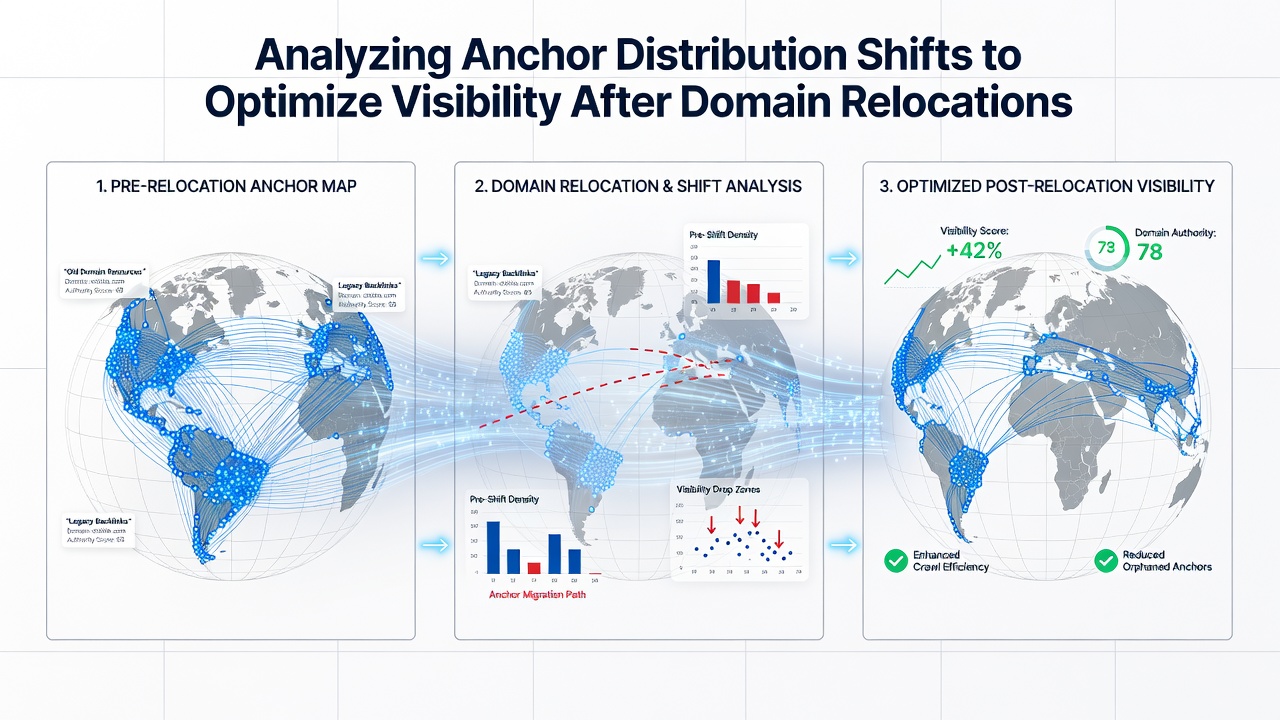
Advanced practitioners segment referring domains by authority tier and topical relevance to isolate which anchor categories drive the largest visibility gains. This segmentation shows that high-authority news domains contribute disproportionately to branded anchor recovery, whereas forum and blog networks often supply the generic and partial-match volume needed for topical breadth. According to a 2025 study published by researchers at the University of Toronto, sites that maintained at least three distinct anchor categories across their top 100 referring domains recovered 35 percent more organic traffic within six months compared to those that allowed concentration in a single category.
Optimization Approaches After Relocation
Once distribution imbalances appear, teams focus on acquiring links with underrepresented anchor types while preserving existing authority signals through proper redirect mapping. Outreach prioritizes domains whose existing anchor profiles complement the gaps identified in the migrated site's data. Evidence from multiple campaigns demonstrates that combining content partnerships with targeted guest contributions produces steadier distribution curves than relying solely on directory submissions or resource page placements. The reality is that anchor optimization remains an ongoing process rather than a one-time fix, because search engines continue to re-crawl and re-evaluate link graphs long after the initial migration completes.
Those managing large portfolios often implement automated alerts that flag when any single anchor category exceeds 45 percent of the total profile. This threshold-based monitoring allows teams to intervene before algorithmic filters treat the profile as manipulative. Data indicates that diversified profiles experience fewer manual review flags during the critical 90-to-180-day window following domain changes.
Conclusion
Anchor distribution analysis provides a concrete framework for understanding and accelerating visibility recovery after domain relocations. Systematic tracking, segmented outreach, and threshold monitoring together form the core practices that data from recent migrations consistently validates. Organizations that integrate these steps into their migration workflows position their new domains to regain and surpass pre-move performance levels within predictable timeframes.